
Stanを使うベイジアンメタアナリシス用のコード:二値変数アウトカムRR, OR, RD用

以前の投稿「Stanを使うベイジアンアプローチのメタアナリシス:Copilotに聞きながら」でRからrstanを介してStanを動かし、メタアナリシスを実行するまでの過程を紹介しました。

今回、リスク比、オッズ比、リスク差を効果指標とするメタアナリシスを実行し、Forest plotを出力するまでの、スクリプトを作成しました。

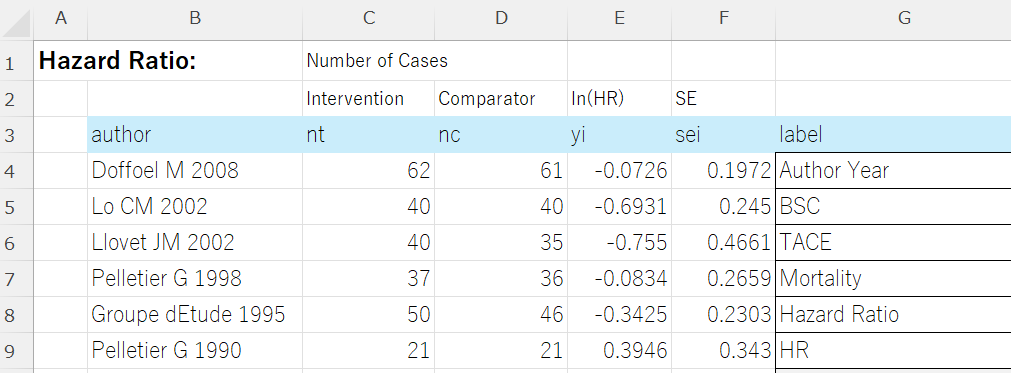
データは、図に示すような形式でExcelで用意します。Risk Ratio、RRのセルをOdds Ratio、ORあるいはRisk Difference、 RDと書き換えて効果指標のタイプを指定します。labelのその他の項目もそれぞれ書き換えてください。この例ではUnvaccinatedのセルが対照の治療、Vaccinatedのセルが介入の治療、TB+のセルがアウトカムになります。効果指標のタイプはRR, OR, RDのラベル名で判断します。

この例では、セルB3からG16の範囲を選択して(データ部分が例えば行7までしかない場合は、セルB3からセルG9の範囲を選択します)、以下のスクリプトをRで実行するとForest plotが出力されます。かなり長いのでアコーディオン形式で畳んだ状態ですが、右端をクリックすると展開され、コード用のフィールドに記述してあります。

コードをすべて、コピーして、RのEditorに貼り付けます。Excelでデータ範囲を選択し、コピー(Ctrl+C)の後、Rに戻り、exdat = read.delim(“clipboard”,sep=”\t”,header=TRUE)の行のスクリプトを実行して、クリップボード経由でデータを読み込みます。その後、それ以降のスクリプトをすべて実行します。

Stanを用いるベイジアンメタアナリシス用コード
#####rstan, StanによるRR, OR, RDのベイジアンメタアナリシス用のスクリプト#####
# 必要なパッケージをロード
library(rstan)
library(bayesplot)
library(dplyr)
library(HDInterval)
library(forestplot)
library(metafor)

# Get data via clipboard.
exdat = read.delim("clipboard",sep="\t",header=TRUE)
labem = exdat[,"label"]
em = labem[6]
labe_study = labem[1]
labe_cont = labem[2]
labe_int = labem[3]
labe_outc = labem[4]
labe_em = labem[5]

# Format the data.
exdati = na.omit(exdat)
if(colnames(exdati)[1]=="author"){
study = exdati$author
}
if(colnames(exdati)[1]=="study"){
study = exdati$study
}
nc = exdati$nc
rc = exdati$rc
nt = exdati$nt
rt = exdati$rt
num_studies = length(study)
N = num_studies
meta_data <- list(
N = num_studies,
study = study,
nc = nc,
rc = rc,
nt = nt,
rt = rt
)

# Stanモデルコード
#RR
if(em == "RR"){
stan_model_code <- "data {
  int<lower=1> N;
  int nc[N];
  int rc[N];
  int nt[N];
  int rt[N];
}

parameters {
  // リスク比 (RR) 用
  real logRR[N];
  real mu_logRR; // リスク比の統合値(対数)
  real<lower=0> sigma_logRR; // リスク比の研究間のばらつき

  real<lower=0, upper=1> p_c[N]; // 対照群のイベント発生確率
}
transformed parameters { // 各研究のlogRR, logOR, RDをここに定義
  vector[N] logRR_study; // 各研究のlogRR

  for (i in 1:N) {
    // これらの値はmu_logRRなどからサンプリングされるものですが、
    // ここで直接観測データから計算された「点推定値」も用意します
    // これらはgenerated quantitiesでしか使わないので、generated quantitiesに移すことも可能
    // ただし、modelブロックで使われている logRR[i] 等と重複しないように注意
    // ここでは、計算の便宜上、rc,nc,rt,nt から直接点推定値を計算します
    real p_c_obs = (rc[i] + 0.5) / (nc[i] + 1.0); // ゼロイベント回避のための補正
    real p_t_obs = (rt[i] + 0.5) / (nt[i] + 1.0);

    logRR_study[i] = log(p_t_obs) - log(p_c_obs);
  }
}
model {
  // 事前分布
  // RR
  mu_logRR ~ normal(0, 10);
  sigma_logRR ~ cauchy(0, 2);

  for (i in 1:N) {
    p_c[i] ~ beta(1, 1); // 対照群のイベント発生確率に対する一様な事前分布

    // RR
    logRR[i] ~ normal(mu_logRR, sigma_logRR);
    rc[i] ~ binomial(nc[i], p_c[i]);
    rt[i] ~ binomial(nt[i], fmin(p_c[i] * exp(logRR[i]), 1)); // RRに基づき介入群のイベント率を計算
  }
}

generated quantities {
  // リスク比 (RR)
  real RR_pooled = exp(mu_logRR);
  real RR_pred = exp(normal_rng(mu_logRR, sigma_logRR));
  real tau_squared_logRR = sigma_logRR * sigma_logRR;

  // 各研究の観測された効果量の標準誤差 (se_obs) を計算
  vector<lower=0>[N] se_logRR_obs;

  // 各効果指標の観測誤差の分散 (variance_obs)
  vector<lower=0>[N] variance_logRR_obs;

  // 典型的な研究内分散 (S_squared)
  real S_squared_logRR;

  for (i in 1:N) {
    // ゼロイベント/総数ゼロを避けるために、0.5の連続性補正を適用
    // 頻度論的なメタアナリシスでよく使われる手法です。
    real current_rc = rc[i] + 0.5;
    real current_nc = nc[i] + 1.0;
    real current_rt = rt[i] + 0.5;
    real current_nt = nt[i] + 1.0;

    // logRR の標準誤差の計算 (デルタ法)
    se_logRR_obs[i] = sqrt(1.0/current_rc - 1.0/current_nc + 1.0/current_rt - 1.0/current_nt);
    variance_logRR_obs[i] = se_logRR_obs[i] * se_logRR_obs[i];

  }

  // 典型的な研究内分散 (S_squared) の計算
  // 各研究の観測誤差の分散の平均値
  S_squared_logRR = mean(variance_logRR_obs);
}"
}
#OR
if(em == "OR"){
stan_model_code <- "data {
  int<lower=1> N;
  int nc[N];
  int rc[N];
  int nt[N];
  int rt[N];
}

parameters {
  // オッズ比 (OR) 用
  real logOR[N];
  real mu_logOR; // オッズ比の統合値(対数)
  real<lower=0> sigma_logOR; // オッズ比の研究間のばらつき
  real<lower=0, upper=1> p_c[N]; // 対照群のイベント発生確率
}
transformed parameters { // 各研究のlogRR, logOR, RDをここに定義
  vector[N] logOR_study; // 各研究のlogOR
  for (i in 1:N) {
    // これらの値はmu_logRRなどからサンプリングされるものですが、
    // ここで直接観測データから計算された「点推定値」も用意します
    // これらはgenerated quantitiesでしか使わないので、generated quantitiesに移すことも可能
    // ただし、modelブロックで使われている logRR[i] 等と重複しないように注意
    // ここでは、計算の便宜上、rc,nc,rt,nt から直接点推定値を計算します
    real p_c_obs = (rc[i] + 0.5) / (nc[i] + 1.0); // ゼロイベント回避のための補正
    real p_t_obs = (rt[i] + 0.5) / (nt[i] + 1.0);
    logOR_study[i] = log((p_t_obs / (1 - p_t_obs))) - log((p_c_obs / (1 - p_c_obs)));
  }
}
model {
  // 事前分布
  // OR
  mu_logOR ~ normal(0, 10);
  sigma_logOR ~ cauchy(0, 2);
  for (i in 1:N) {
    p_c[i] ~ beta(1, 1); // 対照群のイベント発生確率に対する一様な事前分布
    // OR
    logOR[i] ~ normal(mu_logOR, sigma_logOR);
	rc[i] ~ binomial(nc[i], p_c[i]);
    // オッズ比の定義 p_t / (1 - p_t) = OR * (p_c / (1 - p_c)) より p_t を導出
    // logit(p_t) = logOR + logit(p_c)
    // p_t = inv_logit(logOR + logit(p_c))
    rt[i] ~ binomial(nt[i], inv_logit(logOR[i] + logit(p_c[i])));
  }
}
generated quantities {
  // オッズ比 (OR)
  real OR_pooled = exp(mu_logOR);
  real OR_pred = exp(normal_rng(mu_logOR, sigma_logOR));
  real tau_squared_logOR = sigma_logOR * sigma_logOR;

  // 各研究の観測された効果量の標準誤差 (se_obs) を計算
  vector<lower=0>[N] se_logOR_obs;

  // 各効果指標の観測誤差の分散 (variance_obs)
  vector<lower=0>[N] variance_logOR_obs;

  // 典型的な研究内分散 (S_squared)
  real S_squared_logOR;

  for (i in 1:N) {
    // ゼロイベント/総数ゼロを避けるために、0.5の連続性補正を適用
    // 頻度論的なメタアナリシスでよく使われる手法です。
    real current_rc = rc[i] + 0.5;
    real current_nc = nc[i] + 1.0;
    real current_rt = rt[i] + 0.5;
    real current_nt = nt[i] + 1.0;

    // logOR の標準誤差の計算 (デルタ法)
    se_logOR_obs[i] = sqrt(1.0/current_rc + 1.0/(current_nc - current_rc) + 1.0/current_rt + 1.0/(current_nt - current_rt));
    variance_logOR_obs[i] = se_logOR_obs[i] * se_logOR_obs[i];
  }
  // 典型的な研究内分散 (S_squared) の計算
  // 各研究の観測誤差の分散の平均値
  S_squared_logOR = mean(variance_logOR_obs);
}"
}
#RD
if(em == "RD"){
stan_model_code <- "data {
  int<lower=1> N;
  int nc[N];
  int rc[N];
  int nt[N];
  int rt[N];
}
parameters {
  // リスク差 (RD) 用
  real RD[N];
  real mu_RD; // リスク差の統合値
  real<lower=0> sigma_RD; // リスク差の研究間のばらつき

  real<lower=0, upper=1> p_c[N]; // 対照群のイベント発生確率
}
transformed parameters { // 各研究のlogRR, logOR, RDをここに定義
  vector[N] RD_study;    // 各研究のRD
  for (i in 1:N) {
    // これらの値はmu_logRRなどからサンプリングされるものですが、
    // ここで直接観測データから計算された「点推定値」も用意します
    // これらはgenerated quantitiesでしか使わないので、generated quantitiesに移すことも可能
    // ただし、modelブロックで使われている logRR[i] 等と重複しないように注意
    // ここでは、計算の便宜上、rc,nc,rt,nt から直接点推定値を計算します
    real p_c_obs = (rc[i] + 0.5) / (nc[i] + 1.0); // ゼロイベント回避のための補正
    real p_t_obs = (rt[i] + 0.5) / (nt[i] + 1.0);
    RD_study[i] = p_t_obs - p_c_obs;
  }
}
model {
  // 事前分布
  // RD
  mu_RD ~ normal(0, 10);
  sigma_RD ~ cauchy(0, 2);
  for (i in 1:N) {
    p_c[i] ~ beta(1, 1); // 対照群のイベント発生確率に対する一様な事前分布

    // RD
    RD[i] ~ normal(mu_RD, sigma_RD);
	rc[i] ~ binomial(nc[i], p_c[i]);
    // リスク差の定義 p_t - p_c = RD より p_t を導出
    // p_t = p_c + RD
    rt[i] ~ binomial(nt[i], fmin(fmax(p_c[i] + RD[i], 0), 1)); // 0から1の範囲に制限
  }
}
generated quantities {
  // リスク差 (RD)
  real RD_pooled = mu_RD;
  real RD_pred = normal_rng(mu_RD, sigma_RD);
  real tau_squared_RD = sigma_RD * sigma_RD;
  
  // 各研究の観測された効果量の標準誤差 (se_obs) を計算
  vector<lower=0>[N] se_RD_obs;

  // 各効果指標の観測誤差の分散 (variance_obs)
  vector<lower=0>[N] variance_RD_obs;

  // 典型的な研究内分散 (S_squared)
  real S_squared_RD;
  for (i in 1:N) {
    // ゼロイベント/総数ゼロを避けるために、0.5の連続性補正を適用
    // 頻度論的なメタアナリシスでよく使われる手法です。
    real current_rc = rc[i] + 0.5;
    real current_nc = nc[i] + 1.0;
    real current_rt = rt[i] + 0.5;
    real current_nt = nt[i] + 1.0;

    // RD の標準誤差の計算 (デルタ法)
    // p_c = rc/nc, p_t = rt/nt
    // var(RD) = var(p_t - p_c) = var(p_t) + var(p_c) (独立と仮定)
    // var(p) = p*(1-p)/n
    real p_c_calc = current_rc / current_nc;
    real p_t_calc = current_rt / current_nt;
    se_RD_obs[i] = sqrt(p_c_calc * (1.0 - p_c_calc) / current_nc + p_t_calc * (1.0 - p_t_calc) / current_nt);
    variance_RD_obs[i] = se_RD_obs[i] * se_RD_obs[i];
  }
  // 典型的な研究内分散 (S_squared) の計算
  // 各研究の観測誤差の分散の平均値
  S_squared_RD = mean(variance_RD_obs);
}"
}
# 初期値の設定
N <- meta_data$N
init_values <- function() {
  list(
    mu_logRR = 0, sigma_logRR = 1, logRR = rep(0, N),
    mu_logOR = 0, sigma_logOR = 1, logOR = rep(0, N),
    mu_RD = 0, sigma_RD = 1, RD = rep(0, N),
    p_c = rep(0.1, N)
  )
}
# Stanモデルのコンパイルと実行
# ウォームアップ10000回、サンプリングは20000回x4チェインで80000個に設定。適宜変更する。
fit <- stan(model_code = stan_model_code, data = meta_data, init = init_values, iter = 30000, warmup=10000, chains = 4, seed = 123,control = list(adapt_delta = 0.98))
#fit <- stan(model_code = stan_model_code, data = meta_data, init = init_values, iter = 30000, warmup=10000, chains = 4, seed = 123)

# 推定結果の抽出
posterior_samples <- extract(fit)

# --- 結果の表示 ---
## リスク比 (RR)
if(em == "RR"){
cat("--- リスク比 (RR) の結果 ---\n")
mu_logRR_samples <- posterior_samples$mu_logRR
risk_ratio <- exp(mean(mu_logRR_samples))
conf_int_rr <- exp(quantile(mu_logRR_samples, probs = c(0.025, 0.975)))
pi_rr = quantile(posterior_samples$RR_pred, probs = c(0.025, 0.975))	#PI of RR
p_val_rr = round(2*min(mean(mu_logRR_samples >0), mean(mu_logRR_samples <0)), 6)	#Bayesian p-value for summary logRR
if(mean(mu_logRR_samples)>0){
prob_direct_rr = round(mean(mu_logRR_samples > 0),6)
label = "p(RR>1)="
}else{
prob_direct_rr = round(mean(mu_logRR_samples < 0),6)
label = "p(RR<1)="
}
cat("推定されたリスク比:", risk_ratio, "\n")
cat("95% 確信区間:", conf_int_rr[1], "-", conf_int_rr[2]," P=",p_val_rr,label,prob_direct_rr,"\n\n")
cat("95% 推測区間:", pi_rr[1], "-", pi_rr[2])
}
if(em == "OR"){
## オッズ比 (OR)
cat("--- オッズ比 (OR) の結果 ---\n")
mu_logOR_samples <- posterior_samples$mu_logOR
odds_ratio <- exp(mean(mu_logOR_samples))
conf_int_or <- exp(quantile(mu_logOR_samples, probs = c(0.025, 0.975)))
pi_or = quantile(posterior_samples$OR_pred, probs = c(0.025, 0.975))	#PI of OR
p_val_or = round(2*min(mean(mu_logOR_samples >0), mean(mu_logOR_samples <0)), 6)	#Bayesian p-value for summary logOR
if(mean(mu_logOR_samples)>0){
prob_direct_or = round(mean(mu_logOR_samples > 0),6)
label = "p(OR>1)="
}else{
prob_direct_or = round(mean(mu_logOR_samples < 0),6)
label = "p(OR<1)="
}
cat("推定されたオッズ比:", odds_ratio, "\n")
cat("95% 確信区間:", conf_int_or[1], "-", conf_int_or[2]," P=",p_val_or,label,prob_direct_or, "\n\n")
cat("95% 推測区間:", pi_or[1], "-", pi_or[2])
}
if(em == "RD"){
## リスク差 (RD)
cat("--- リスク差 (RD) の結果 ---\n")
mu_RD_samples <- posterior_samples$mu_RD
risk_difference <- mean(mu_RD_samples)
conf_int_rd <- quantile(mu_RD_samples, probs = c(0.025, 0.975))
pi_rd = quantile(posterior_samples$RD_pred, probs = c(0.025, 0.975))	#PI of RD
p_val_rd = round(2*min(mean(mu_RD_samples >0), mean(mu_RD_samples <0)), 6)	#Bayesian p-value for summary RD
if(mean(mu_RD_samples)>0){
prob_direct_rd = round(mean(mu_RD_samples > 0),6)
label = "p(RD>0)="
}else{
prob_direct_rd = round(mean(mu_RD_samples < 0),6)
label = "p(RD<0)="
}
cat("推定されたリスク差:", risk_difference, "\n")
cat("95% 確信区間:", conf_int_rd[1], "-", conf_int_rd[2]," P=",p_val_rd,label,prob_direct_rd, "\n")
cat("95% 推測区間:", pi_rd[1], "-", pi_rd[2])
}
#######
#各研究の効果指標と95%確信区間の値
if(em == "RR"){
# リスク比
rr=rep(0,N)
rr_lw=rep(0,N)
rr_up=rep(0,N)
for(i in 1:N){
rr[i] = exp(mean(posterior_samples$logRR[,i]))
rr_lw[i] = exp(quantile(posterior_samples$logRR[,i],probs=0.025))
rr_up[i] = exp(quantile(posterior_samples$logRR[,i],probs=0.975))
}
}
if(em == "OR"){
#オッズ比
or=rep(0,N)
or_lw=rep(0,N)
or_up=rep(0,N)
for(i in 1:N){
or[i] = exp(mean(posterior_samples$logOR[,i]))
or_lw[i] = exp(quantile(posterior_samples$logOR[,i],probs=0.025))
or_up[i] = exp(quantile(posterior_samples$logOR[,i],probs=0.975))
}
}
if(em == "RD"){
#リスク差
rd=rep(0,N)
rd_lw=rep(0,N)
rd_up=rep(0,N)
for(i in 1:N){
rd[i] = mean(posterior_samples$RD[,i])
rd_lw[i] = quantile(posterior_samples$RD[,i],probs=0.025)
rd_up[i] = quantile(posterior_samples$RD[,i],probs=0.975)
}
}
#####
#####I-squared:
if(em == "RR"){
# --- リスク比 (logRR) の I-squared 計算 ---
tau_squared_logRR_samples <- posterior_samples$tau_squared_logRR
S_squared_logRR_from_stan <- posterior_samples$S_squared_logRR[1] # S_squaredは各イテレーションで同じ値なので、最初の要素でOK

# 各イテレーションでI-squaredを計算
I_squared_logRR_samples <- (tau_squared_logRR_samples / (tau_squared_logRR_samples + S_squared_logRR_from_stan)) * 100

# I-squaredの点推定値(平均値)と95%確信区間を計算
#mean_I_squared_logRR <- mean(I_squared_logRR_samples)
#ci_I_squared_logRR <- quantile(I_squared_logRR_samples, probs = c(0.025, 0.975))
#mode and HDI (high density interval) RR
dens=density(I_squared_logRR_samples)
mean_I_squared_logRR=dens$x[which.max(dens$y)]	#mode
ci_I_squared_logRR=hdi(I_squared_logRR_samples)	#High Density Interval (HDI) lower and upper.

cat(paste0("--- I-squared for Log Relative Risk ---\n"))
cat(paste0("Estimated I-squared (Mode): ", round(mean_I_squared_logRR, 2), "%\n"))
cat(paste0("95% High Density Interval for I-squared: ", round(ci_I_squared_logRR[1], 2), "% - ", round(ci_I_squared_logRR[2], 2), "%\n"))
}
if(em == "OR"){
# --- オッズ比 (logOR)ついても同様に計算 ---
tau_squared_logOR_samples <- posterior_samples$tau_squared_logOR
S_squared_logOR_from_stan <- posterior_samples$S_squared_logOR[1] # S_squaredは各イテレーションで同じ値なので、最初の要素でOK
# ... 同様の計算 ...
# 各イテレーションでI-squaredを計算
I_squared_logOR_samples <- (tau_squared_logOR_samples / (tau_squared_logOR_samples + S_squared_logOR_from_stan)) * 100

# I-squaredの点推定値(平均値)と95%確信区間を計算
#mean_I_squared_logOR <- mean(I_squared_logOR_samples)
#ci_I_squared_logOR <- quantile(I_squared_logOR_samples, probs = c(0.025, 0.975))
#mode and HDI (High Density Interval) OR
dens=density(I_squared_logOR_samples)
mean_I_squared_logOR=dens$x[which.max(dens$y)]	#mode
ci_I_squared_logOR=hdi(I_squared_logOR_samples)	#High Density Interval (HDI) lower and upper.

cat(paste0("--- I-squared for Log Odds Ratio ---\n"))
cat(paste0("Estimated I-squared (Mode): ", round(mean_I_squared_logOR, 2), "%\n"))
cat(paste0("95% High Density Interval for I-squared: ", round(ci_I_squared_logOR[1], 2), "% - ", round(ci_I_squared_logOR[2], 2), "%\n"))
}
if(em == "RD"){
# --- リスク差 (RD) についても同様に計算 ---
tau_squared_RD_samples <- posterior_samples$tau_squared_RD
S_squared_RD_from_stan <- posterior_samples$S_squared_RD[1] # S_squaredは各イテレーションで同じ値なので、最初の要素でOK
# ... 同様の計算 ...
# 各イテレーションでI-squaredを計算
I_squared_RD_samples <- (tau_squared_RD_samples / (tau_squared_RD_samples + S_squared_RD_from_stan)) * 100

# I-squaredの点推定値(平均値)と95%確信区間を計算
#mean_I_squared_RD <- mean(I_squared_RD_samples)
#ci_I_squared_RD <- quantile(I_squared_RD_samples, probs = c(0.025, 0.975))
#mode and HDI (High Density Interval) RD
dens=density(I_squared_RD_samples)
mean_I_squared_RD=dens$x[which.max(dens$y)]	#mode
ci_I_squared_RD=hdi(I_squared_RD_samples)	#High Density Interval (HDI) lower and upper.

cat(paste0("--- I-squared for Risk Difference ---\n"))
cat(paste0("Estimated I-squared (Mode): ", round(mean_I_squared_RD, 2), "%\n"))
cat(paste0("95% High Density Interval for I-squared: ", round(ci_I_squared_RD[1], 2), "% - ", round(ci_I_squared_RD[2], 2), "%\n"))
}
#####
####MCMC diagnostic####
#MCMC trace plot: logRR
#dev.new();mcmc_dens(as.matrix(fit, pars = c("logRR","tau_squared_logRR")))
#dev.new();mcmc_trace(fit, pars = c("mu_logRR", "sigma_logRR"))
#Pairs plot
#dev.new();mcmc_pairs(fit, pars = c("mu_logRR", "sigma_logRR"))

#### Forest plot #####
#Risk Ratio (RR)
if(em == "RR"){
# 重みを格納するベクトルを初期化
weights <- numeric(N)
weight_percentages <- numeric(N)

for (i in 1:N) {
  # i番目の研究のlogRRのサンプリング値を取得
  log_RR_i_samples <- posterior_samples$logRR[, i]
  # そのサンプリングされた値の分散を計算
  # これを「実効的な逆分散」と考える
  variance_of_logRR_i <- var(log_RR_i_samples)
  # 重みは分散の逆数
  weights[i] <- 1 / variance_of_logRR_i
}
# 全重みの合計
total_weight <- sum(weights)
# 各研究の重みのパーセンテージ
weight_percentages <- (weights / total_weight) * 100
# 結果の表示
results_weights_posterior_var <- data.frame(
  Study = 1:N,
  Effective_Weight = weights,
  Effective_Weight_Percentage = weight_percentages
)
print(results_weights_posterior_var)
k=N
wpc = format(round(weight_percentages,digits=1), nsmall=1)
wp = weight_percentages/100
#Forest plot box sizes on weihts
wbox=c(NA,NA,(k/4)*sqrt(wp)/sum(sqrt(wp)),0.5,0,NA)	
#wbox=c(NA,NA,(k/5)*sqrt(wp)/sum(sqrt(wp)),0.5,0,NA)
###### tau-squared
# logRR の tau^2
tau_squared_logRR_samples <- posterior_samples$tau_squared_logRR
#mean_tau_squared_logRR <- mean(tau_squared_logRR_samples)
#ci_tau_squared_logRR <- quantile(tau_squared_logRR_samples, probs = c(0.025, 0.975))
#mode and HDI (High Density Interval) logRR tau-squared
dens=density(tau_squared_logRR_samples)
mean_tau_squared_logRR=dens$x[which.max(dens$y)]	#mode
ci_tau_squared_logRR=hdi(tau_squared_logRR_samples)	#High Density Interval (HDI) lower and upper.

print(paste("Estimated tau-squared (logRR, mode):", mean_tau_squared_logRR))
print(paste("95% High Density Interval for tau-squared (logRR):", ci_tau_squared_logRR[1], "-", ci_tau_squared_logRR[2]))

#Forest plot by forestplot
#setting fs for cex
fs=1
if(k>20){fs=round((1-0.02*(k-20)),digits=1)}

m=c(NA,NA,rr,risk_ratio,risk_ratio,NA)
lw=c(NA,NA,rr_lw,conf_int_rr[1],pi_rr[1],NA)
up=c(NA,NA,rr_up,conf_int_rr[2],pi_rr[2],NA)

hete1=""
hete2=paste("I2=",round(mean_I_squared_logRR, 2),"%",sep="")

hete3=paste("tau2=",format(round(mean_tau_squared_logRR,digits=4),nsmall=4),sep="")

#hete2=paste("I2=",round(mean_I_squared_logRR, 2), "%\n"," (",round(ci_I_squared_logRR[1], 2)," ~ ",
#round(ci_I_squared_logRR[2], 2),")",sep="")

#hete3=paste("tau2=",format(round(mean_tau_squared_logRR,digits=4),nsmall=4), "\n",
#" (",format(round(ci_tau_squared_logRR[1],digits=4),nsmall=4)," ~ ",
#format(round(ci_tau_squared_logRR[2],digits=4),nsmall=4),")  ",sep="")

hete4=""
hete5=paste("p=",p_val_rr, sep="")
hete6=paste(label,prob_direct_rr,sep="")

au=study
sl=c(NA,toString(labe_study),as.vector(au),"Summary Estimate","Prediction Interval",NA)

ncl=c(labe_cont,"Number",nc,NA,NA,hete1)
rcl=c(NA,labe_outc,rc,NA,NA,hete2)

ntl=c(labe_int,"Number",nt,NA,NA,hete3)
rtl=c(NA,labe_outc,rt,NA,NA,hete4)

spac=c("    ",NA,rep(NA,k),NA,NA,NA)
ml=c(NA,labe_em,format(round(rr,digits=3),nsmall=3),format(round(risk_ratio,digits=3),nsmall=3),NA,hete5)
ll=c(NA,"95% CI lower",format(round(rr_lw,digits=3),nsmall=3),format(round(conf_int_rr[1],digits=3),nsmall=3),format(round(pi_rr[1],digits=3),nsmall=3),hete6)
ul=c(NA,"95% CI upper",format(round(rr_up,digits=3),nsmall=3),format(round(conf_int_rr[2],digits=3),nsmall=3),format(round(pi_rr[2],digits=3),nsmall=3),NA)
wpcl=c(NA,"Weight(%)",wpc,100,NA,NA)
ll=as.vector(ll)
ul=as.vector(ul)
sum=c(TRUE,TRUE,rep(FALSE,k),TRUE,FALSE,FALSE)
zerov=1
labeltext=cbind(sl,ntl,rtl,ncl,rcl,spac,ml,ll,ul,wpcl)
hlines=list("3"=gpar(lwd=1,columns=1:11,col="grey"))
dev.new()
plot(forestplot(labeltext,mean=m,lower=lw,upper=up,is.summary=sum,graph.pos=7,
zero=zerov,hrzl_lines=hlines,xlab=toString(labe_em),txt_gp=fpTxtGp(ticks=gpar(cex=fs),
xlab=gpar(cex=fs),cex=fs),xticks.digits=2,vertices=TRUE,graphwidth=unit(50,"mm"),colgap=unit(3,"mm"),
boxsize=wbox,
lineheight="auto",xlog=TRUE,new_page=FALSE))
}
#clip=c(clipl,clipu),
##############################################
#Odds Ratio (OR)
if(em == "OR"){
# 重みを格納するベクトルを初期化
weights <- numeric(N)
weight_percentages <- numeric(N)

for (i in 1:N) {
  # i番目の研究のlogRRのサンプリング値を取得
  log_OR_i_samples <- posterior_samples$logOR[, i]
  # そのサンプリングされた値の分散を計算
  # これを「実効的な逆分散」と考える
  variance_of_logOR_i <- var(log_OR_i_samples)
  # 重みは分散の逆数
  weights[i] <- 1 / variance_of_logOR_i
}
# 全重みの合計
total_weight <- sum(weights)
# 各研究の重みのパーセンテージ
weight_percentages <- (weights / total_weight) * 100
# 結果の表示
results_weights_posterior_var <- data.frame(
  Study = 1:N,
  Effective_Weight = weights,
  Effective_Weight_Percentage = weight_percentages
)
print(results_weights_posterior_var)
k=N
wpc = format(round(weight_percentages,digits=1), nsmall=1)
wp = weight_percentages/100
#Forest plot box sizes on weihts
wbox=c(NA,NA,(k/4)*sqrt(wp)/sum(sqrt(wp)),0.5,0,NA)	
#wbox=c(NA,NA,(k/5)*sqrt(wp)/sum(sqrt(wp)),0.5,0,NA)
###### tau-squared
# logOR の tau^2
tau_squared_logOR_samples <- posterior_samples$tau_squared_logOR
#mean_tau_squared_logOR <- mean(tau_squared_logOR_samples)
#ci_tau_squared_logOR <- quantile(tau_squared_logOR_samples, probs = c(0.025, 0.975))
#mode and HDI (High Density Interval) logOR tau-squared
dens=density(tau_squared_logOR_samples)
mean_tau_squared_logOR=dens$x[which.max(dens$y)]	#mode
ci_tau_squared_logOR=hdi(tau_squared_logOR_samples)	#High Density Interval (HDI) lower and upper.

print(paste("Estimated tau-squared (logOR, mode):", mean_tau_squared_logOR))
print(paste("95% High Density Interval for tau-squared (logOR):", ci_tau_squared_logOR[1], "-", ci_tau_squared_logOR[2]))

#Forest plot by forestplot
#setting fs for cex
fs=1
if(k>20){fs=round((1-0.02*(k-20)),digits=1)}

m=c(NA,NA,or,odds_ratio,odds_ratio,NA)
lw=c(NA,NA,or_lw,conf_int_or[1],pi_or[1],NA)
up=c(NA,NA,or_up,conf_int_or[2],pi_or[2],NA)

hete1=""
hete2=paste("I2=",round(mean_I_squared_logOR, 2),"%",sep="")

hete3=paste("tau2=",format(round(mean_tau_squared_logOR,digits=4),nsmall=4),sep="")

#hete2=paste("I2=",round(mean_I_squared_logOR, 2), "%\n"," (",round(ci_I_squared_logOR[1], 2)," ~ ",
#round(ci_I_squared_logOR[2], 2),")",sep="")

#hete3=paste("tau2=",format(round(mean_tau_squared_logOR,digits=4),nsmall=4), "\n",
#" (",format(round(ci_tau_squared_logOR[1],digits=4),nsmall=4)," ~ ",
#format(round(ci_tau_squared_logOR[2],digits=4),nsmall=4),")  ",sep="")

hete4=""
hete5=paste("p=",p_val_or, sep="")
hete6=paste(label,prob_direct_or,sep="")

au=study
sl=c(NA,toString(labe_study),as.vector(au),"Summary Estimate","Prediction Interval",NA)

ncl=c(labe_cont,"Number",nc,NA,NA,hete1)
rcl=c(NA,labe_outc,rc,NA,NA,hete2)

ntl=c(labe_int,"Number",nt,NA,NA,hete3)
rtl=c(NA,labe_outc,rt,NA,NA,hete4)

spac=c("    ",NA,rep(NA,k),NA,NA,NA)
ml=c(NA,labe_em,format(round(or,digits=3),nsmall=3),format(round(odds_ratio,digits=3),nsmall=3),NA,hete5)
ll=c(NA,"95% CI lower",format(round(or_lw,digits=3),nsmall=3),format(round(conf_int_or[1],digits=3),nsmall=3),format(round(pi_or[1],digits=3),nsmall=3),hete6)
ul=c(NA,"95% CI upper",format(round(or_up,digits=3),nsmall=3),format(round(conf_int_or[2],digits=3),nsmall=3),format(round(pi_or[2],digits=3),nsmall=3),NA)
wpcl=c(NA,"Weight(%)",wpc,100,NA,NA)
ll=as.vector(ll)
ul=as.vector(ul)
sum=c(TRUE,TRUE,rep(FALSE,k),TRUE,FALSE,FALSE)
zerov=1
labeltext=cbind(sl,ntl,rtl,ncl,rcl,spac,ml,ll,ul,wpcl)
hlines=list("3"=gpar(lwd=1,columns=1:11,col="grey"))
dev.new()
plot(forestplot(labeltext,mean=m,lower=lw,upper=up,is.summary=sum,graph.pos=7,
zero=zerov,hrzl_lines=hlines,xlab=toString(labe_em),txt_gp=fpTxtGp(ticks=gpar(cex=fs),
xlab=gpar(cex=fs),cex=fs),xticks.digits=2,vertices=TRUE,graphwidth=unit(50,"mm"),colgap=unit(3,"mm"),
boxsize=wbox,
lineheight="auto",xlog=TRUE,new_page=FALSE))
}

#############################################
#####Risk Difference
if(em == "RD"){
# 重みを格納するベクトルを初期化
weights <- numeric(N)
weight_percentages <- numeric(N)

for (i in 1:N) {
  # i番目の研究のlogRRのサンプリング値を取得
  RD_i_samples <- posterior_samples$RD[, i]
  # そのサンプリングされた値の分散を計算
  # これを「実効的な逆分散」と考える
  variance_of_RD_i <- var(RD_i_samples)
  # 重みは分散の逆数
  weights[i] <- 1 / variance_of_RD_i
}
# 全重みの合計
total_weight <- sum(weights)
# 各研究の重みのパーセンテージ
weight_percentages <- (weights / total_weight) * 100
# 結果の表示
results_weights_posterior_var <- data.frame(
  Study = 1:N,
  Effective_Weight = weights,
  Effective_Weight_Percentage = weight_percentages
)
print(results_weights_posterior_var)
k=N
wpc = format(round(weight_percentages,digits=1), nsmall=1)
wp = weight_percentages/100
#Forest plot box sizes on weihts
wbox=c(NA,NA,(k/4)*sqrt(wp)/sum(sqrt(wp)),0.5,0,NA)	
#wbox=c(NA,NA,(k/5)*sqrt(wp)/sum(sqrt(wp)),0.5,0,NA)
###### tau-squared
# RD の tau^2
tau_squared_RD_samples <- posterior_samples$tau_squared_RD
#mean_tau_squared_RD <- mean(tau_squared_RD_samples)
#ci_tau_squared_RD <- quantile(tau_squared_RD_samples, probs = c(0.025, 0.975))
#mode and HDI (High Density Interval) logOR tau-squared
dens=density(tau_squared_RD_samples)
mean_tau_squared_RD=dens$x[which.max(dens$y)]	#mode
ci_tau_squared_RD=hdi(tau_squared_RD_samples)	#High Density Interval (HDI) lower and upper.

print(paste("Estimated tau-squared (RD, mode):", mean_tau_squared_RD))
print(paste("95% High Density Interval for tau-squared (RD):", ci_tau_squared_RD[1], "-", ci_tau_squared_RD[2]))

#Forest plot by forestplot
#setting fs for cex
fs=1
if(k>20){fs=round((1-0.02*(k-20)),digits=1)}

m=c(NA,NA,rd,risk_difference,risk_difference,NA)
lw=c(NA,NA,rd_lw,conf_int_rd[1],pi_rd[1],NA)
up=c(NA,NA,rd_up,conf_int_rd[2],pi_rd[2],NA)

hete1=""
hete2=paste("I2=",round(mean_I_squared_RD, 2),"%",sep="")

hete3=paste("tau2=",format(round(mean_tau_squared_RD,digits=4),nsmall=4),sep="")

#hete2=paste("I2=",round(mean_I_squared_RD, 2), "%\n"," (",round(ci_I_squared_RD[1], 2)," ~ ",
#round(ci_I_squared_RD[2], 2),")",sep="")

#hete3=paste("tau2=",format(round(mean_tau_squared_RD,digits=4),nsmall=4), "\n",
#" (",format(round(ci_tau_squared_RD[1],digits=4),nsmall=4)," ~ ",
#format(round(ci_tau_squared_RD[2],digits=4),nsmall=4),")  ",sep="")

hete4=""
hete5=paste("p=",p_val_rd, sep="")
hete6=paste(label,prob_direct_rd,sep="")

au=study
sl=c(NA,toString(labe_study),as.vector(au),"Summary Estimate","Prediction Interval",NA)

ncl=c(labe_cont,"Number",nc,NA,NA,hete1)
rcl=c(NA,labe_outc,rc,NA,NA,hete2)

ntl=c(labe_int,"Number",nt,NA,NA,hete3)
rtl=c(NA,labe_outc,rt,NA,NA,hete4)

spac=c("    ",NA,rep(NA,k),NA,NA,NA)
ml=c(NA,labe_em,format(round(rd,digits=3),nsmall=3),format(round(risk_difference,digits=3),nsmall=3),NA,hete5)
ll=c(NA,"95% CI lower",format(round(rd_lw,digits=3),nsmall=3),format(round(conf_int_rd[1],digits=3),nsmall=3),format(round(pi_rd[1],digits=3),nsmall=3),hete6)
ul=c(NA,"95% CI upper",format(round(rd_up,digits=3),nsmall=3),format(round(conf_int_rd[2],digits=3),nsmall=3),format(round(pi_rd[2],digits=3),nsmall=3),NA)
wpcl=c(NA,"Weight(%)",wpc,100,NA,NA)
ll=as.vector(ll)
ul=as.vector(ul)
sum=c(TRUE,TRUE,rep(FALSE,k),TRUE,FALSE,FALSE)
zerov=0
labeltext=cbind(sl,ntl,rtl,ncl,rcl,spac,ml,ll,ul,wpcl)
hlines=list("3"=gpar(lwd=1,columns=1:11,col="grey"))
dev.new()
plot(forestplot(labeltext,mean=m,lower=lw,upper=up,is.summary=sum,graph.pos=7,
zero=zerov,hrzl_lines=hlines,xlab=toString(labe_em),txt_gp=fpTxtGp(ticks=gpar(cex=fs),
xlab=gpar(cex=fs),cex=fs),xticks.digits=2,vertices=TRUE,graphwidth=unit(50,"mm"),colgap=unit(3,"mm"),
boxsize=wbox,
lineheight="auto",xlog=FALSE,new_page=FALSE))
}
####
###Pint indiv estimates with CI and copy to clipboard.
nk=k+2
efs=rep("",nk)
efeci=rep("",nk)
for(i in 1:nk){
efs[i]=ml[i+2]
efeci[i]=paste(ll[i+2],"~",ul[i+2])
}
efestip=data.frame(cbind(efs,efeci))
efestip[nk,1]=""
print(efestip)
write.table(efestip,"clipboard",sep="\t",row.names=FALSE,col.names=FALSE)
print("The estimates of each study and the summary estimate are in the clipboard.")
#############################################

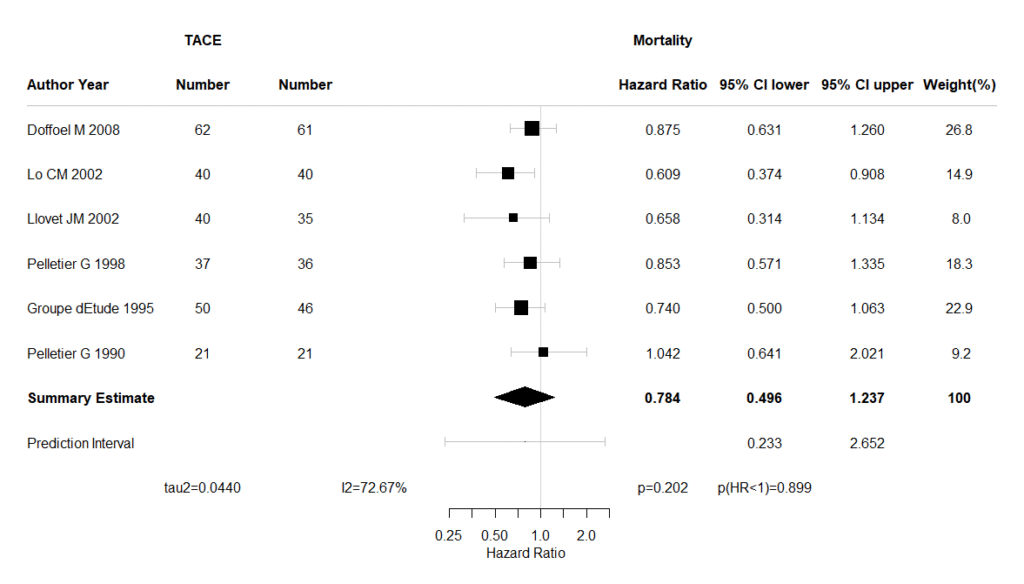
出力されたForest plotですが、確信区間だけでなく予測区間も出力します。Forest plotが出力された時点で各研究の効果推定値、95%確信区間、統合値とその95%確信区間、予測区間の値をコンソールに出力するとともに、クリップボードにコピーしますので、Excelの評価シートなどに結果の値を貼り付けることができます。

必要なパッケージがインストールされていない場合、以下のスクリプトを先に実行してください。未インストールのパッケージがインストールされます。metaforも含めました。また、RでStanを動かすためには、RToolsのインストールも必要になります。こちらから、Rのバージョンに合わせたバージョンのRToolsをダウンロードしてインストールしてください(430MB くらいある大きなプログラムです)。URL https://cran.r-project.org/bin/windows/Rtools/ 詳細は前の投稿を参照してください。

####Install packages for the first time####
packneed=c("rstan","Rcpp","ggplot2","coda","dplyr","forestplot","bayesplot","HDInterval","metafor");current=installed.packages();addpack=setdiff(packneed,rownames(current));url="https://ftp.yz.yamagata-u.ac.jp/pub/cran/";if(length(addpack)>0){install.packages(addpack,repos=url)};if(length(addpack)==0){print("Already installed.")}

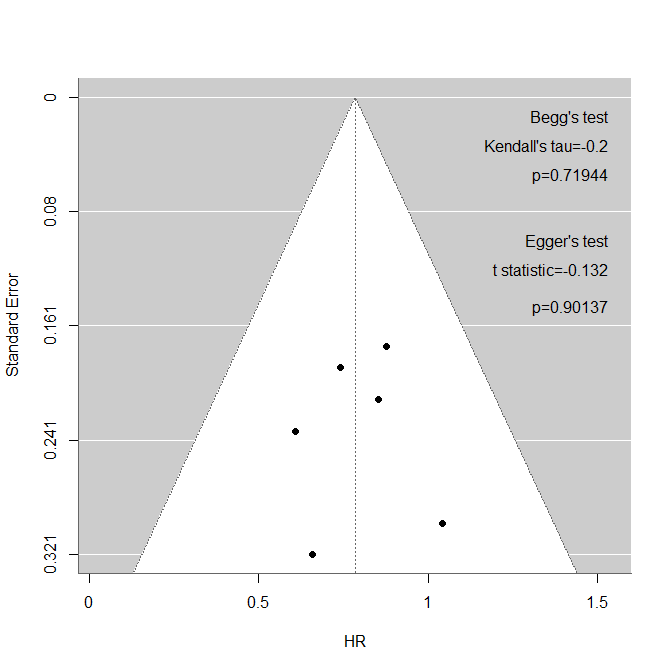
Funnel plot作成のためのスクリプトを作成しました。Forest plotが出力された後に実行するとFunnel plotが出力されます。また、統計学的な非対称性の検定法である、Beggの検定、Eggerの検定も実行します。最後まで実行するとFunnel plot内にこれら検定の結果も書き出します。Funnel plotだけで十分な場合は、後半のAsymmetry test with Egger and Begg’s tests.の行以下のスクリプトは実行する必要がありません。また、Funnel plotは研究数が10(少なくとも5)件以上の場合に意味があるとされていますが、このスクリプトでは数による制限はしていませんの。

Funnel plot作成のためのスクリプト
########################
library(metafor)

#Plot funnel plot.
if(em == "RR"){
yi = log(rr)
vi=1/weights
sei = sqrt(1/weights)
mu = log(risk_ratio)
dev.new(width=7,height=7)
funnel(yi, sei = sei, level = c(95), refline = mu,xlab = "log(RR)", ylab = "Standard Error")
}

if(em == "OR"){
yi = log(or)
vi=1/weights
sei = sqrt(1/weights)
mu = log(odds_ratio)
dev.new(width=7,height=7)
funnel(yi, sei = sei, level = c(95), refline = mu,xlab = "log(OR)", ylab = "Standard Error")
}

if(em == "RD"){
yi = rd
vi=1/weights
sei = sqrt(1/weights)
mu = risk_difference
dev.new(width=7,height=7)
funnel(yi, sei = sei, level = c(95), refline = mu,xlab = "RD", ylab = "Standard Error")
}

#Asymmetry test with Egger and Begg's tests.
egger=regtest(yi, sei=sei,model="lm", ret.fit=FALSE)
begg=ranktest(yi, vi)

#Print the results to the console.
print("Egger's test:")
print(egger)
print("Begg's test")
print(begg)

#Add Begg and Egger to the plot.
fsfn=1
em=toString(exdat$label[6])
outyes=toString(exdat$label[4])
funmax=par("usr")[3]-par("usr")[4]
gyou=funmax/12
fxmax=par("usr")[2]-(par("usr")[2]-par("usr")[1])/40
text(fxmax,gyou*0.5,"Begg's test",pos=2,cex=fsfn)
kentau=toString(round(begg$tau,digits=3))
text(fxmax,gyou*1.2,paste("Kendall's tau=",kentau,sep=""),pos=2,cex=fsfn)
kenp=toString(round(begg$pval,digits=5))
text(fxmax,gyou*1.9,paste("p=",kenp,sep=""),pos=2,cex=fsfn)

text(fxmax,gyou*3.5,"Egger's test",pos=2,cex=fsfn)
tstat=toString(round(egger$zval,digits=3))
text(fxmax,gyou*4.2,paste("t statistic=",tstat,sep=""),pos=2,cex=fsfn)
tstap=toString(round(egger$pval,digits=5))
text(fxmax,gyou*5.1,paste("p=",tstap,sep=""),pos=2,cex=fsfn)
#####################################

GRADE contextulizationによる分類は今後使用しない

2025年7月のAnnals of Internal MedicineにSchünemann教授たちがGRADE working groupの2024年9月の決定事項として、今後エビデンスの確実性評価の際に文脈化Contextualizationによる最小文脈化アプローチMinimally contextualized appproach、部分的文脈化のアプローチPartially contextualized approach完全文脈化のアプローチFully contextualized approachという言う分類はやめることにしたというショートレポートが出されています。引き続き、より詳細が論文として報告されるそうです。

Hultcrantz M, Schünemann HJ, Mustafa RA, Rind DM, Murad MH, Mayer M, Tovey D, Alper BS, Akl EA, Saif-Ur-Rahman KM, Sousa-Pinto B, Neumann I, Izcovich A, Guyatt G: GRADE Certainty Ratings: Thresholds Rather Than Categories of Contextualization (GRADE Guidance 41). Ann Intern Med 2025;178:1183-1186. doi: 10.7326/ANNALS-25-00548 PMID: 40587852

臨床の文脈、医療環境の文脈、医療資源の文脈など、文脈といわれるとより想起されやすい別の事項があるため、混乱を招く恐れがあるからそうしたらしいです。

ただし、エビデンスの確実性評価の方法・手順が変更になったわけではありません。小・中・大の決断閾値Decision thresholdsを設定して、アウトカムの重要度で重みづけした効果推定値の95%信頼区間/確信区間の交差の程度を見て、不精確性Imprecisionの評価をする、必要な場合はReview Information Size (RIS)も評価するという点は同じです。Imprecisionと他のドメイン、例えば、非一貫性Inconsistency, バイアスリスクRisk of bias等とのInteraction/相関関係を考慮し、グレードダウンは保守的に、というのも変わらないと思います。

「正味の益も考慮して決断閾値を設定した」、「当該アウトカムだけを考慮し、パネルメンバーの考えに基づいて閾値を設定した」、「他のアウトカムに対する効果の大きさと確実性も考慮して決断閾値を設定した」、「当該アウトウカムの重要性に関する報告に基づいて閾値を設定した」などと記述することになるのでしょう。

以前の投稿「GRADEアプローチのエビデンスの確実性評価:3種類の文脈化」はこちら

関連文献:

Hultcrantz M, et al: The GRADE Working Group clarifies the construct of certainty of evidence. J Clin Epidemiol 2017;87:4-13. doi: 10.1016/j.jclinepi.2017.05.006 PMID: 28529184

Alper BS, et al: Defining certainty of net benefit: a GRADE concept paper. BMJ Open 2019;9:e027445. doi: 10.1007/s11882-011-0185-8 PMID: 31167868

Zeng L, et al: GRADE guidelines 32: GRADE offers guidance on choosing targets of GRADE certainty of evidence ratings. J Clin Epidemiol 2021;137:163-175. doi: 10.1016/j.jclinepi.2021.03.026 PMID: 33857619

Schünemann HJ, et al: GRADE guidance 35: update on rating imprecision for assessing contextualized certainty of evidence and making decisions. J Clin Epidemiol 2022;150:225-242. doi: 10.1016/j.jclinepi.2022.07.015 PMID: 35934266

GRADE EtDフレームワークとMCDA

GRADE (Evidence-to-Decision) EtDフレームワークは複数の基準項目について、リサーチエビデンスと追加的考察に基づいて判断し、全体をまとめて推奨を作成する枠組みですが、診療ガイドライン作成パネルの議論・審議をリードするのが大きな役割です。

Multi-Criteria Decision Analysis (MCDA)多基準意思決定分析(多基準決断分析)では複数の基準項目(アウトカムなど)についてパフォーマンス(効果の大きさ)と基準項目の重要度から重みづけ加算モデルで一つの値を計算し、それによって最善の選択肢を決めることができます。評価者の価値観により重要度を変えて、それぞれに最善の選択肢を選択することに役立ちます。

GRADE EtDフレームワークもMCDAも思想的な背景は同じです。前者は議論・審議に重きを置き、後者は関係するパラメータを数値化して定量的に評価します。これら2つのアプローチの関係を理解することと、診療ガイドラインの推奨作成にMCDAを活用できるようにすることは重要だと思います。

解説動画とPDFを作成しました。

PDF 「GRADE EtDフレームワークとMCDAの関係性」

動画はNotebookLMで作成しました。PDFファイルはGammaで作成しました。

主な文献:
Alonso-Coello P, Oxman AD, Moberg J, Brignardello-Petersen R, Akl EA, Davoli M, Treweek S, Mustafa RA, Vandvik PO, Meerpohl J, Guyatt GH, Schünemann HJ, GRADE Working Group: GRADE Evidence to Decision (EtD) frameworks: a systematic and transparent approach to making well informed healthcare choices. 2: Clinical practice guidelines. BMJ 2016;353:i2089. doi: 10.1136/bmj.i2089 PMID: 27365494

Alonso-Coello P, Schünemann HJ, Moberg J, Brignardello-Petersen R, Akl EA, Davoli M, Treweek S, Mustafa RA, Rada G, Rosenbaum S, Morelli A, Guyatt GH, Oxman AD, GRADE Working Group: GRADE Evidence to Decision (EtD) frameworks: a systematic and transparent approach to making well informed healthcare choices. 1: Introduction. BMJ 2016;353:i2016. doi: 10.1136/bmj.i2016 PMID: 27353417

Moberg J, Alonso-Coello P, Oxman AD. GRADE Evidence to Decision (EtD) Frameworks Guidance. Version 1.1 [updated May 2015], The GRADE Working Group, 2015. Available from:
https://ietd.epistemonikos.org/#/help/guidance

FDAのStructured Benefit-Risk FrameworkとPatient’s preference information (PPI)

FDA(米国食品医薬品局)の医療機器・放射線保健センター(CDRH)と医療機器イノベーションコンソーシアム(MDIC)が共同で開発したMDIC患者中心ベネフィット・リスク(PCBR)フレームワークについて、以前紹介しました(351, 436)。

当局の許認可を目的とする治験で、Patient’s preference information(PPI, 患者の選好に関する情報)を調査、記録することが重視されており、申請時にStructured Benefit Risk Frameworkを用いることが求められているようです。

今回、これらについてまとめて、2つのPDFファイルを作成しました。作成にはGoogle NotebookLMgammaを使いました。

・FDAのStructured Benefit-Risk Framework: 医薬品評価における透明性と一貫性の確保 PDF

・FDAのStructured Benefit-Risk Frameworkと患者選好情報 (PPI) PDF

用語を確認しておきましょう:

Importance of outcome アウトカムの重要性/重要度、Values価値観、Preferences選好の関係は以下の様に表現されると思います。GRADE Working Groupはアウトカムの重要度と患者の価値観は同じことを意味しており、文脈により使い分けると述べています。

文献:
Ho M, Saha A, McCleary KK, Levitan B, Christopher S, Zandlo K, Braithwaite RS, Hauber AB: A Framework for Incorporating Patient Preferences Regarding Benefits and Risks into Regulatory Assessment of Medical Technologies. Value Health. 2016;19:746-750. doi: 10.1016/j.jval.2016.02.019 doi: 10.1016/j.jval.2016.02.019 PMID: 27712701

•Boyd CM, Singh S, Varadhan R, Weiss CO, Sharma R, Bass EB, Puhan MA. Methods for Benefit and Harm Assessment in Systematic Reviews. Methods Research Report. (Prepared by the Johns Hopkins University Evidence-based Practice Center under contract No. 290-2007-10061-I). AHRQ Publication No. 12(13)-EHC150-EF. Rockville, MD: Agency for Healthcare Research and Quality; November 2012. Link

Alper BS, Oettgen P, Kunnamo I, Iorio A, Ansari MT, Murad MH, Meerpohl JJ, Qaseem A, Hultcrantz M, Schünemann HJ, Guyatt G, GRADE Working Group: Defining certainty of net benefit: a GRADE concept paper. BMJ Open 2019;9:e027445. PMID: 31167868